
Cold feet, right now?
A ceramic heater is
just right.

The short version…
- About ¥37.2 an hour on high (1,200W), or about ¥6.2 for 10 minutes
- Warm air in seconds. Perfect for the changing room, toilet or under your desk
- For heating a room for hours, an air conditioner is cheaper
Electricity cost calculator
Ceramic heaters usually use 600W to 1,200W. Many switch between 1,200W (high) and 600W (low).
Estimated at 31 yen/kWh (the guideline unit price from Japan's National Fair Trade Council of Household Electric Appliances, revised July 2022). Your real cost depends on your contract and area.
Note: electricity on this page is priced at a flat 31 yen/kWh nationwide (National Fair Trade Council guideline).
 Professor Plug
Switch to low, use a motion sensor so it stops when nobody's there, and let the air conditioner heat the room while this one warms your feet. Those three habits cut the bill a lot.
Want the details? (tap to open)
Who it suits, and who it doesn't
○ Good for you if…
- You want a few minutes of warmth after a bath or while getting dressed
- Your feet get cold while working from home
- You need heat where there's no air conditioner (toilet, changing room, kitchen)
- You don't have much space
× Not for you if…
- You want to heat the living room all day
- Keeping the bill as low as possible is your top priority
- You dislike blowing air or fan noise
- You want to keep it on all night in the bedroom
 Hodoyo-kun
How it works, and where it shines
Electricity heats a ceramic plate inside, and a fan blows the heat out as warm air. There's no flame, so it doesn't pollute the air and you don't need to ventilate.
Great spots, poor spots
* Only splash-proof models can be used near water. Always check the installation section of the manual.
5 tips for choosing
-
Pick the wattage by where you'll use it
For the toilet, changing room or under a desk, a small ~600W model is enough. For helping heat a kitchen or living room, go for 1,200W. Also check the room size listed on the box (適用畳数).Where Size Cost per hour Toilet, changing room, under a desk ~600W about 18.6 yen Kitchen, extra heat for living room 1,200W (high/low) about 37.2 yen (high) -
A motion sensor covers for forgetting to switch it off
It runs only while someone is there and stops automatically when they leave. It's most useful in places you only stay briefly, like the toilet. -
Check 4 safety features
Tip-over switch, overheat protection, auto shut-off if left on, and a child lock if you have kids. -
Oscillation and room-temperature sensor for bigger spaces
Oscillation helps when two or more people share it; a temperature sensor keeps the room steady for longer use. Under a desk, you won't miss them. -
Size, weight and noise
If you'll carry it around, about 1 kg is easy. For the bedroom or online meetings, look for a quiet mode.
Common mistakes
Instead: let the air conditioner heat the room and use the ceramic heater just for your feet
Instead: don't run 1,200W on high at the same time as other big appliances. Use low in the changing room
Instead: keep it away from anything that can burn. Don't use it to dry clothes
Instead: don't point it at yourself for long. Use a humidifier too
Good to know if you live in Japan
-
Buy a heater made for Japan (100V)
Japan's household power is 100V. A heater built for 220–240V countries won't work properly here, and adapters don't fix that. Choose a model sold in Japan. -
Look for the PSE mark
Electric heaters, electric blankets and kotatsu are covered by Japan's Electrical Appliances and Materials Safety Act. Products sold in Japan must carry the PSE mark. Be careful with very cheap imports from marketplaces. -
Manuals are usually in Japanese
Many makers post their manuals as PDFs on their websites. A camera-translation app works well for the safety page and the control panel. -
Shopping in English
Amazon.co.jp can be switched to English in the language settings. Product titles are often still in Japanese. Search with the Japanese name (shown on this page) to find more options. -
Your price per kWh may differ
We calculate with 31 yen/kWh, the guideline price used in Japanese catalogs. Your actual price depends on your power company and plan. Check your monthly bill (検針票 / your company's app).
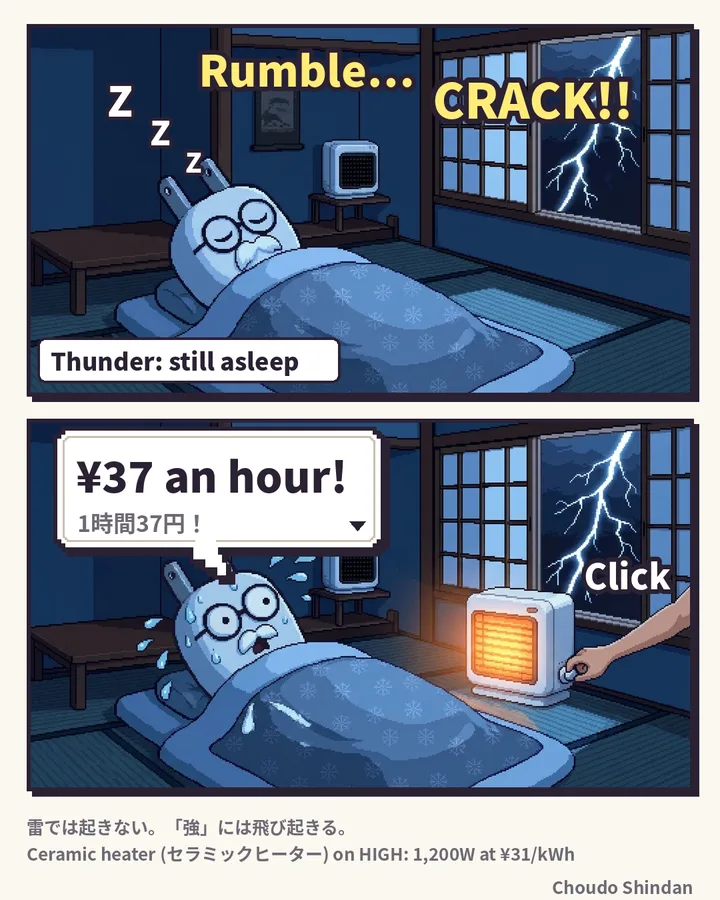
A little comic
Related videos and comics
We put a taxi-style meter on a ceramic heater on HIGH
On HIGH (1,200W) it costs about ¥37 an hour at ¥31/kWh. To heat a whole room, an air conditioner is cheaper.
Japanese audio with English subtitles. The video loads from YouTube only when you tap it.
FAQ
Can I leave it on while I sleep?
It has no flame, so no fire risk?
Do halogen or carbon heaters cost less to run?
Can it heat a whole room?
How many years does a ceramic heater last?
How much does a small 600W ceramic heater cost per hour?
Still not sure?
7 questions to find the heater that's just right for you.